What is Particle Image Velocimetry?
Particle Image Velocimetry (PIV) is an optical flow-measurement technique used to visualize and quantify fluid motion.
A laser or light sheet illuminates tracer particles seeded into a flow — water, air, or open-channel streams — and a
high-speed camera captures two frames in rapid succession. By cross-correlating small interrogation windows between
frames, the technique recovers a dense velocity vector field across the entire image plane.
PIV is non-intrusive (no probes in the flow), highly accurate, and produces spatially rich data that single-point
sensors like ADCPs or current meters cannot match. This makes it ideal for studying turbulent structures,
shear layers, vortex dynamics, and complex boundary conditions in both laboratory and field settings.
Applications at the USGS and Beyond
The USGS uses PIV and image-based velocimetry (including Large-Scale PIV and optical flow methods) to measure
surface velocities in rivers, streams, and canals — especially during flood events when wading measurements
become dangerous or impossible. Cameras mounted on bridges, drones, or bank structures capture tracer motion
(natural surface features, foam, or seeded particles), and PIV algorithms convert that imagery into discharge
estimates used for water resource management, flood forecasting, and infrastructure safety.
Beyond federal streamflow monitoring, PIV is critical in offshore engineering (wave-current interaction),
environmental hydraulics (fish passage, sediment transport), and biomedical flows (cardiac and respiratory
fluid dynamics). Anywhere you need a full-field, non-contact velocity measurement, PIV is the gold standard.
How the Simulator Works
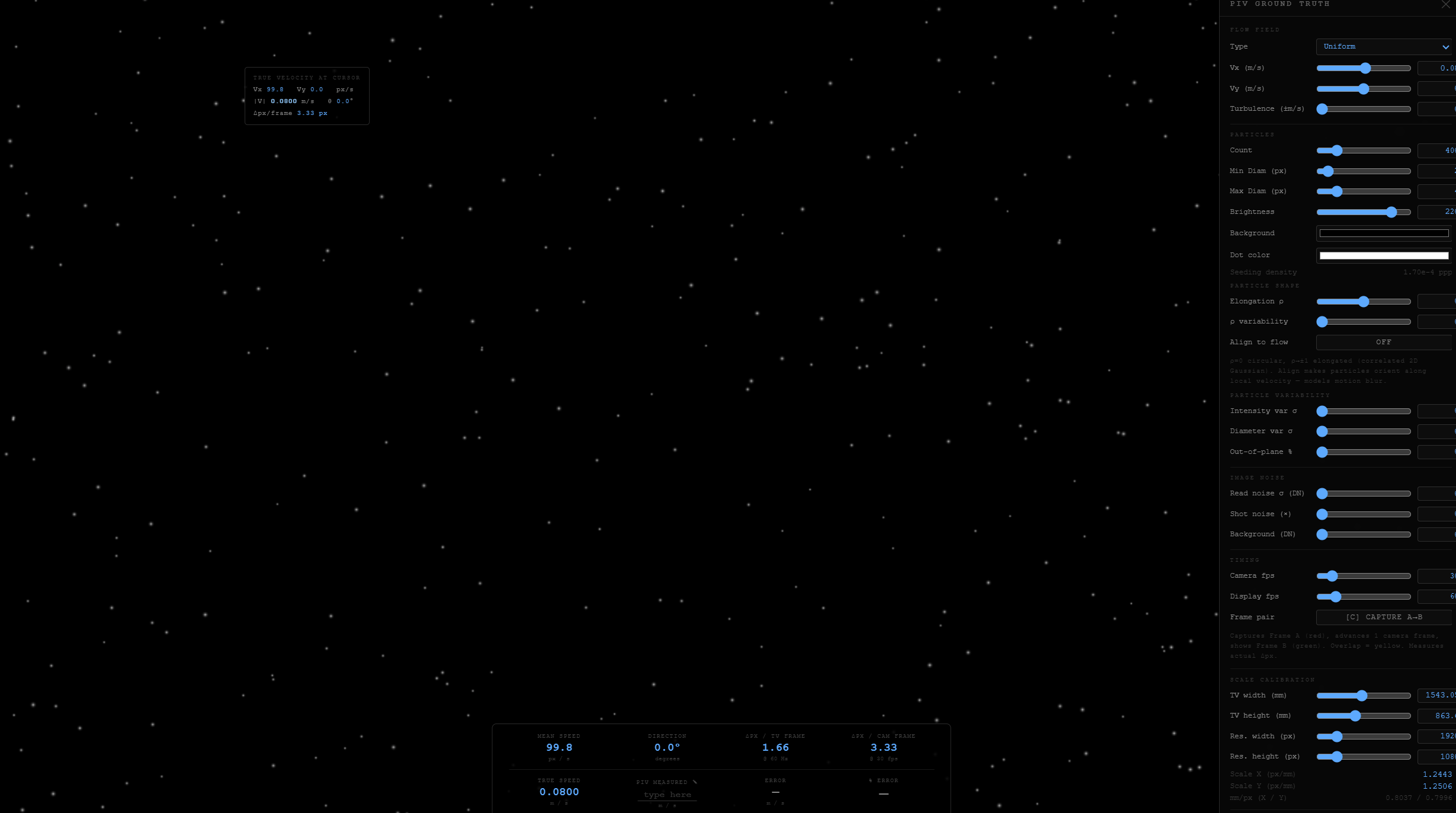
This browser-based tool generates synthetic particle image pairs with a known, mathematically exact velocity
field — the ground truth. You configure the flow type, particle properties, image noise, and camera
timing, then run your PIV algorithm on the output. By comparing your measured velocity against the known
truth, you can quantify algorithm accuracy, optimize interrogation window sizes, and validate your
processing pipeline before deploying it on real experimental data.
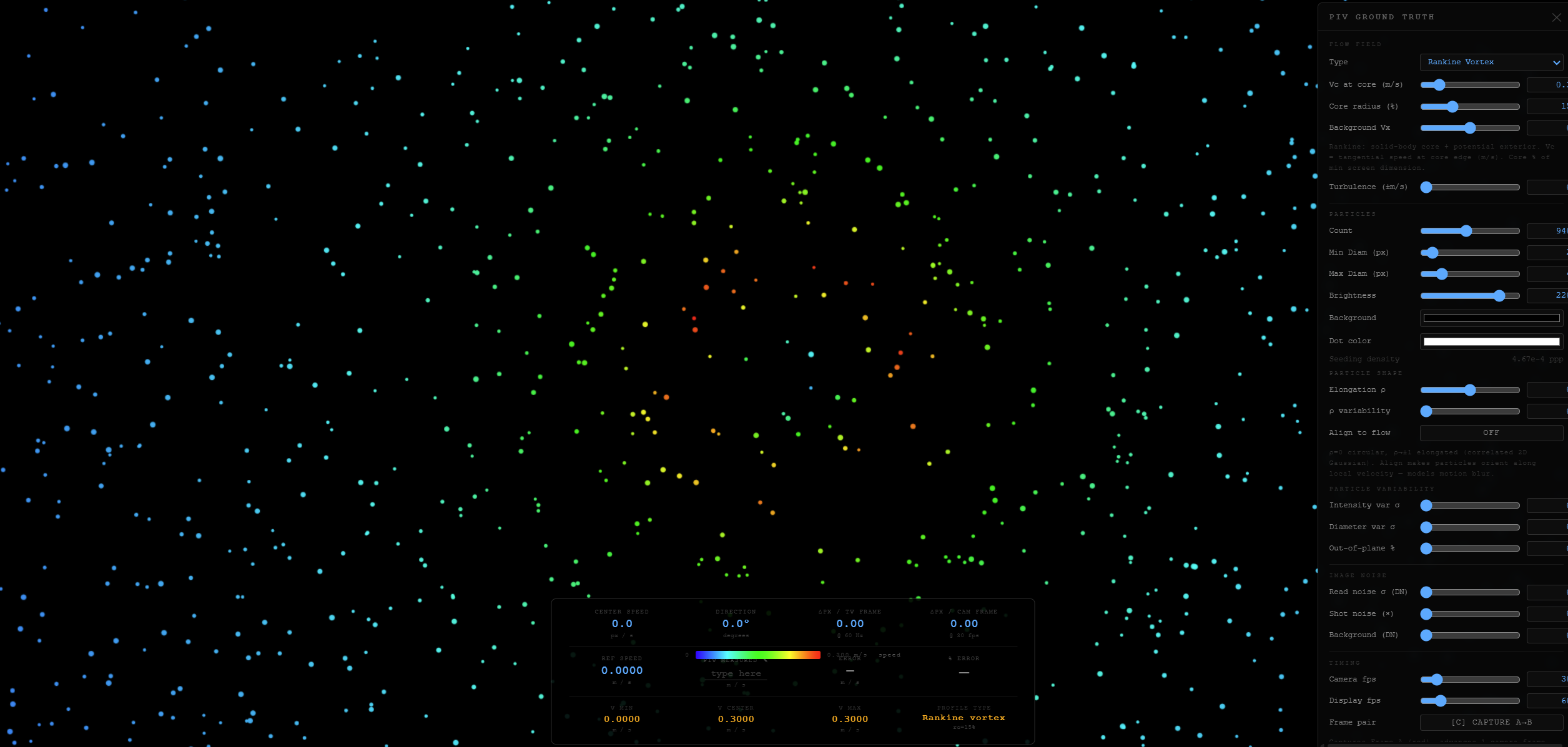
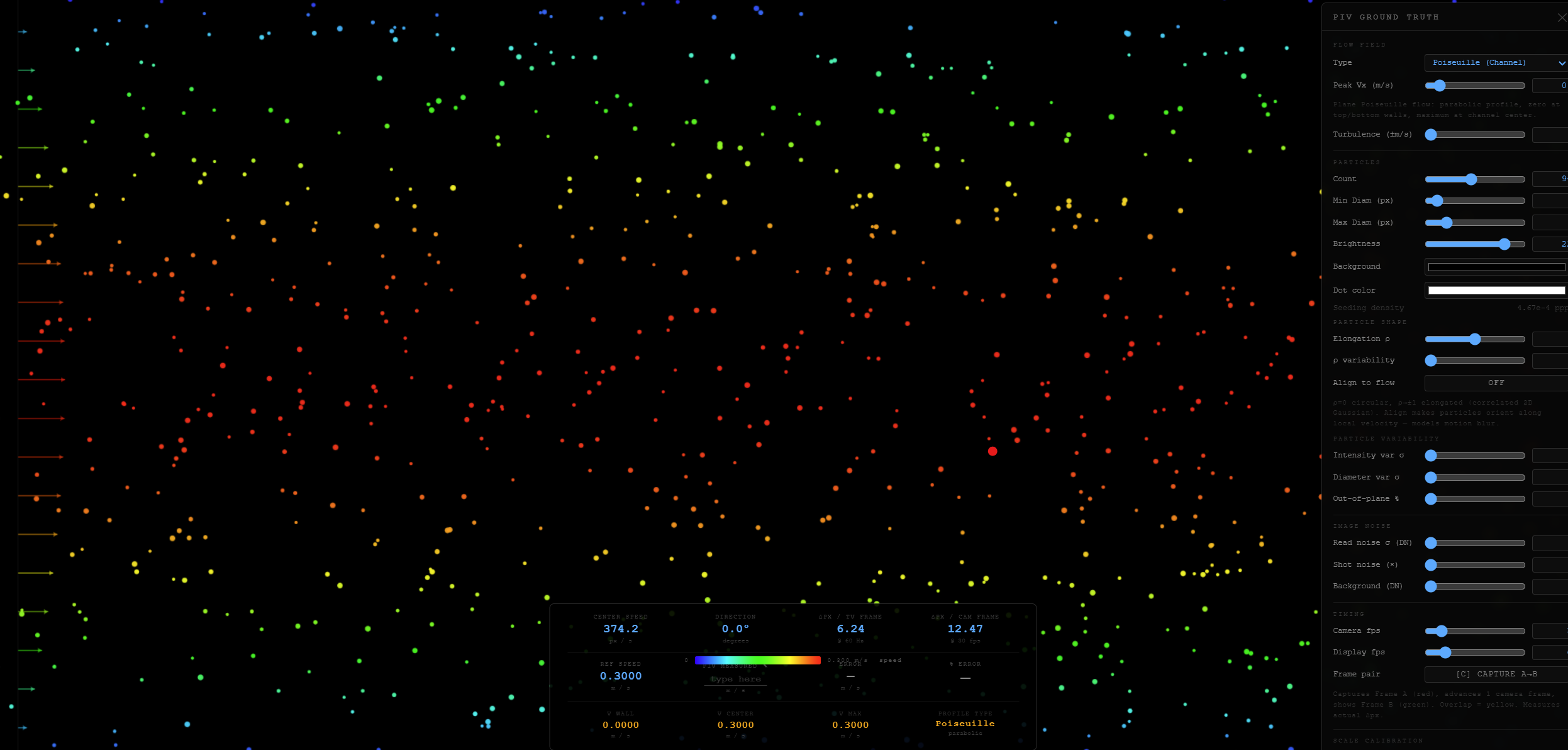
Flow types: Uniform, Linear Shear, Poiseuille (channel), Solid-Body Vortex, Rankine Vortex.
Particle controls: Count, size distribution, shape elongation (ρ), intensity variability,
out-of-plane loss, turbulence intensity.
Noise models: Read noise (Gaussian σ), shot noise (Poisson-approximate), uniform background pedestal.
Scale calibration: Real-world mm/px conversion for physical velocity output in m/s.
QA Suite: Standardized automated tests that score your algorithm against known displacements
— exportable as a CSV report.